
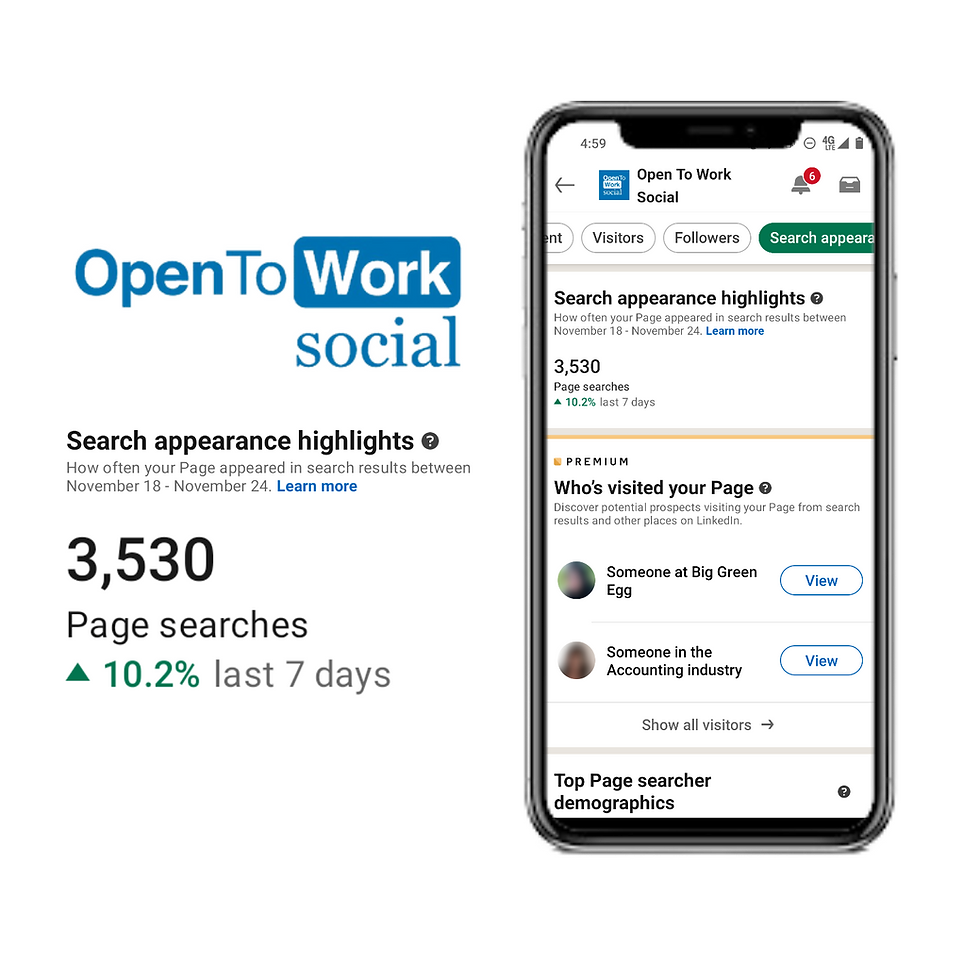
Why Open To Work Social Showed Up in 3,500+ Searches This Week
Updated: Dec 29, 2025
And why that matters for your job search, your hiring strategy, and your personal brand.
Last week, our Open To Work Social LinkedIn page appeared in 3,530 search results — a 10.2% jump in just seven days.
That stat is exciting, sure.
But the reason behind it is much more interesting:
👉 LinkedIn has built a massive “Open to Work” ecosystem to fuel its business model.
👉 We’ve built an entirely separate platform around the same phrase — but with a totally different purpose.
And now the two worlds are colliding in a way that gives job seekers, recruiters, and hiring teams free extra visibility they’ve never had before.
Let’s unpack what’s happening — and how you can take advantage of it.

1. LinkedIn Turned “Open to Work” Into an Engine — for Itself
When LinkedIn launched the “Open to Work” feature, it was pitched as a way for job seekers to quietly (or publicly) signal they were looking for new opportunities.
It worked. Today:
• Around 75% of job seekers say they use LinkedIn in their search.
• Between 72–94% of recruiters use LinkedIn at some point in their hiring process.
At the same time, LinkedIn has quietly become a recruiting powerhouse:
Its Talent Solutions business (recruiter tools, job posts, hiring products) surpassed $7 billion in revenue in a recent 12-month period.
Overall LinkedIn revenue is nearing $18 billion annually, with Talent Solutions being the largest chunk and still growing.
So when LinkedIn boosts anything with the label “Open to Work”, it’s not just because they care about job seekers (even though many people inside LinkedIn absolutely do).
It’s because this is their core business:
helping companies pay to access talent at scale.
Their algorithms, features, and product roadmap naturally optimize for that.
2. The Side Effect: Our Name Rides the Same Wave
Here’s where it gets interesting.
We named our platform Open To Work Social because we believe:
Finding a job should start with your story, and lead to your résumé — not the other way around.
We didn’t pick the name for SEO reasons.
We picked it because it captured the mission.
But now that LinkedIn and the wider job market have essentially branded an entire category around “Open to Work,” we’re seeing a powerful side effect...
Whenever someone searches for:
“Open to work help”
“Open to work tips”
“Open to work platform”
“Open to work social”
…our brand increasingly surfaces — both on LinkedIn and on Google.
That’s how we ended up appearing in 3,530+ searches this week alone, and that number is trending up.
In other words:
LinkedIn built the megaphone.
We built a different message — but the sound still carries.
And you, as a job seeker or recruiter, can benefit from both.
3. The Resume Black Hole Is Real — and Getting Worse
To understand why a story-first platform matters, we have to look at what’s happening in the job market right now.
A few sobering datapoints:
• Automated hiring tools and ATS platforms reject around 75–80% of applicants before a human ever sees their résumé.
At many companies, a single decent job posting receives 200–500 applications, and top-tier employers routinely see 1,000+. Most never get read.
Upwards of 90% of companies now use an Applicant Tracking System (ATS), creating a technical gate between your application and an actual person.
Generative AI tools have caused job applications to spike by more than 45% in a single year, with an estimated 11,000 applications submitted every minute across platforms like LinkedIn.
In short:
We’ve automated the job search so aggressively that it’s now statistically similar to throwing your résumé into a black hole and hoping for the best.
This is great for platforms that sell more tools, more job posts, and more filters.
It is not great for real humans on either side:
Job seekers feel invisible and burned out.
HR teams are drowning in noise and pressured to “fix it with more tech.”
4. Why “More Horsepower” Isn’t the Answer
Recently, I spoke with a human resources leader whose team serves 1,200 employees and processes about 4,000 résumés per vacancy.
Her first instinct?
“I need a better way to sort the résumés faster.”
It’s a reasonable reaction. But it’s the wrong question.
To explain why, I asked her:
“Do you know why we measure car engines in ‘horsepower’?”
She didn’t.
Historically, when people were transitioning from horses to “horseless carriages,” they needed a way to understand the new in terms of the old.
Horsepower was a marketing invention — a metaphor — that stuck. There’s no actual horse inside your engine. We just needed a bridge concept.
Right now, HR departments are doing the same thing:
• We had résumés.
• Then we got more résumés.
• So we built tools to sort résumés faster.
• Then AI started blasting out even more “perfect” résumés.
• So now we’re funding even smarter tools to sort them.
We’re asking for a faster horse instead of asking:
“Maybe we need a different solution all together?"
Because the truth is:
The more we optimize the résumé-sorting machine, the more job seekers are forced to optimize résumé-blasting machines...and the cycle accelerates.
No one wins — except the platforms selling the horsepower.
5. What If the Answer Is Simpler: Stories Over Sorting
The one thing algorithms can’t genuinely replicate is lived experience told in a human voice.
A résumé can be rewritten by AI in seconds.
A story can’t. At least not in a way that truly feels like you.
That’s the core idea behind Open To Work Social:
Instead of trying to out-engineer résumé black holes...what if we made it easier to share real stories — and easier for humans to find them?
So we built a platform where:
• Job seekers answer six thoughtful interview questions about their work, their approach, and the role they’re seeking.
• They upload a photo.
• We publish it as a magazine-style feature — the kind of narrative you’d expect to see in Forbes or a Sunday business section.
Each article lives on its own URL, is indexable by Google, and is designed to be shared on LinkedIn, email, or directly with hiring managers.
Now imagine being a recruiter or hiring manager...
Instead of sifting through 400 nearly identical résumés,
You skim a handful of well-written stories, each one giving you…
• Context
• Values
• Thought process
• Leadership style
• Career direction
From there, you click to view the person’s résumé or profile if the story resonates.
That’s not just more humane.
It’s also dramatically more efficient — because you’re starting with signal, not noise.
6. Why LinkedIn and Google Are Accidentally Helping You If You Use Open To Work Social
Here’s where things get really powerful.
When you publish on Open To Work Social, you’re not choosing between platforms.
You’re stacking their strengths.
1️⃣ LinkedIn’s #OpenToWork Ecosystem
You can post your article link on LinkedIn using #OpenToWork and other hashtags.
LinkedIn’s algorithms already favor content related to job search, career stories, and hiring — because that’s core to its business.
Your story sits in a curated environment only about careers and hiring, not lost in a feed about everything from crypto hot takes to AI memes.
Recruiters browsing our Magazine, Editorials, or Social sections see your story in a context where they’re already in “evaluate talent” mode.
3️⃣ Google & Organic Search
Each feature is its own webpage, with your name, industry, and keywords in the text.
Over time, as more people read and share your article, it becomes an asset that can show up in search when someone Googles you or your niche.
All three combined are why we’re now seeing our page appear in thousands of searches per week — and why our members are quietly benefitting from that halo effect.
7. “Free” With No Catch: How We Actually Make Money
Any time someone hears “free platform,” their guard (rightfully) goes up.
Usually “free” means:
• You’re the product.
• Your data is being resold.
• You’ll be upsold into a subscription.
• You’ll be smothered with ads.
We made a very different choice.
Open To Work Social is free for job seekers, recruiters, and hiring teams.
Instead of selling your attention to advertisers across millions of impressions, we created a Monthly Rewards Program, inspired by:
• T-Mobile Tuesdays
• MetroPCS Rewards
• Chase Offers / Sapphire rewards
Brands pay us to place an exclusive reward or discount in our monthly drop:
• BOGO offers
• Trials
• Member-only discounts
Perks that align with our audience of professionals and job seekers
On the first Tuesday of each month, members can log in, see what’s new, and redeem any offers they like — without being chased by retargeting ads across the internet.
For brands, it’s like having a mini loyalty program inside a career platform — at a fraction of the price of a big-box rewards network.
For our members, it means:
• The platform stays free.
• The content stays about careers and stories, not ad clutter.
• You get actual value each month, whether you’re between roles or already employed.
That’s how we keep the lights on without charging the people who are already under the most pressure.
8. Why This Moment Matters — and How to Use It
Right now, three major trends are colliding:
1. Job applications are exploding thanks to AI-generated résumés and one-click apply tools.
2. Automated filters are getting harsher, with ATS systems screening out the majority of candidates before a human ever looks.
3. Platforms like LinkedIn are investing heavily in #OpenToWork features, recruiter tools, and verification systems, because hiring revenue is their largest growth engine.
In that environment, just doing “more of the same” — more résumés, more job boards, more filters — will only get you further lost in the noise.
But the same environment is also creating a huge opportunity:
✓ People are actively searching for “Open to work” content.
✓ Recruiters are actively searching for credible, visible candidates.
✓ Companies are actively searching for ways to hire that feel more human again.
That’s why Open To Work Social is surfacing in thousands of searches a week.
We’re not trying to replace LinkedIn.
We’re building the story layer that LinkedIn, traditional ATS systems, and job boards never truly prioritized.
9. What You Can Do Today (Job Seekers, Recruiters, Employers)
If you’re a job seeker:
1. Start your free magazine interview.
2. Answer six questions honestly — about your work, your values, and the role you want next.
3. Upload a photo, publish, and then share your article on LinkedIn with #OpenToWork and other relevant hashtags.
4. Add the link to your résumé, email signature, and messages to recruiters.
If you’re a recruiter or HR leader:
1. Get featured in our Recruiters & HR interview series.
2. Use your article as a credibility piece with clients and candidates.
3. Share how you really think about hiring — beyond the script of a job post.
If you’re an employer or brand:
1. Browse candidate stories directly, starting from who they are, not just where they’ve worked.
2. Consider placing an offer in our Monthly Rewards Program to get in front of job seekers and professionals with positive intent.
10. The Bottom Line
Open To Work Social showing up in 3,500+ searches in a week isn’t just a vanity metric.
It’s a signal that:
• The world is paying attention to “Open to Work.”
• People are hungry for more humane, story-driven ways to connect talent with opportunity.
• Platforms that center the human story — not just the résumé — are finally getting their moment.
If you’re tired of throwing your résumé into a black hole, or tired of sorting through piles of nearly identical applications, you don’t need faster horses.
You need better stories.
And that’s exactly what we’re here to help you tell.
👉 Start your story here: https://www.opentoworksocial.com


Comments